Showing posts with label technique. Show all posts

Thursday, October 30, 2014

Do you shoot Sony cameras? Here's the biggest unknown tip ever.

  This autumn I spent some time down in the West Elk mountains of Colorado. All I can say is is a very huge "wow". If you've never been there you really need to put it on the "must do" list. An amazing place that really is a photographers heaven. Like any other photographer, I was both anxious and excited to get home and begin processing my photographs. So when I did I was rather startled by what I found.

  I shoot Sony cameras. Right now that consists of a Sony A77 and a Sony A550 as my backup camera. There's a few things inside Sony cameras which sets them apart from others; most notably is what is called "DRO", basically it stands for "Dynamic Range Optimization". It is basically leased technology from a company named Apical  and Nikon uses their technology as well, the difference however is that Nikon, unlike Sony, didn't provide them a "chip" which from my understanding basically fine tunes things. Now I know, this is really in the weeds stuff here but hang with me. 


  Now I imagine most photographers workflow these days consists of basically this;

*Download photos to computer
*Open Lightroom
*Import photos
*Process
*Maybe touch up in Photoshop
*Save

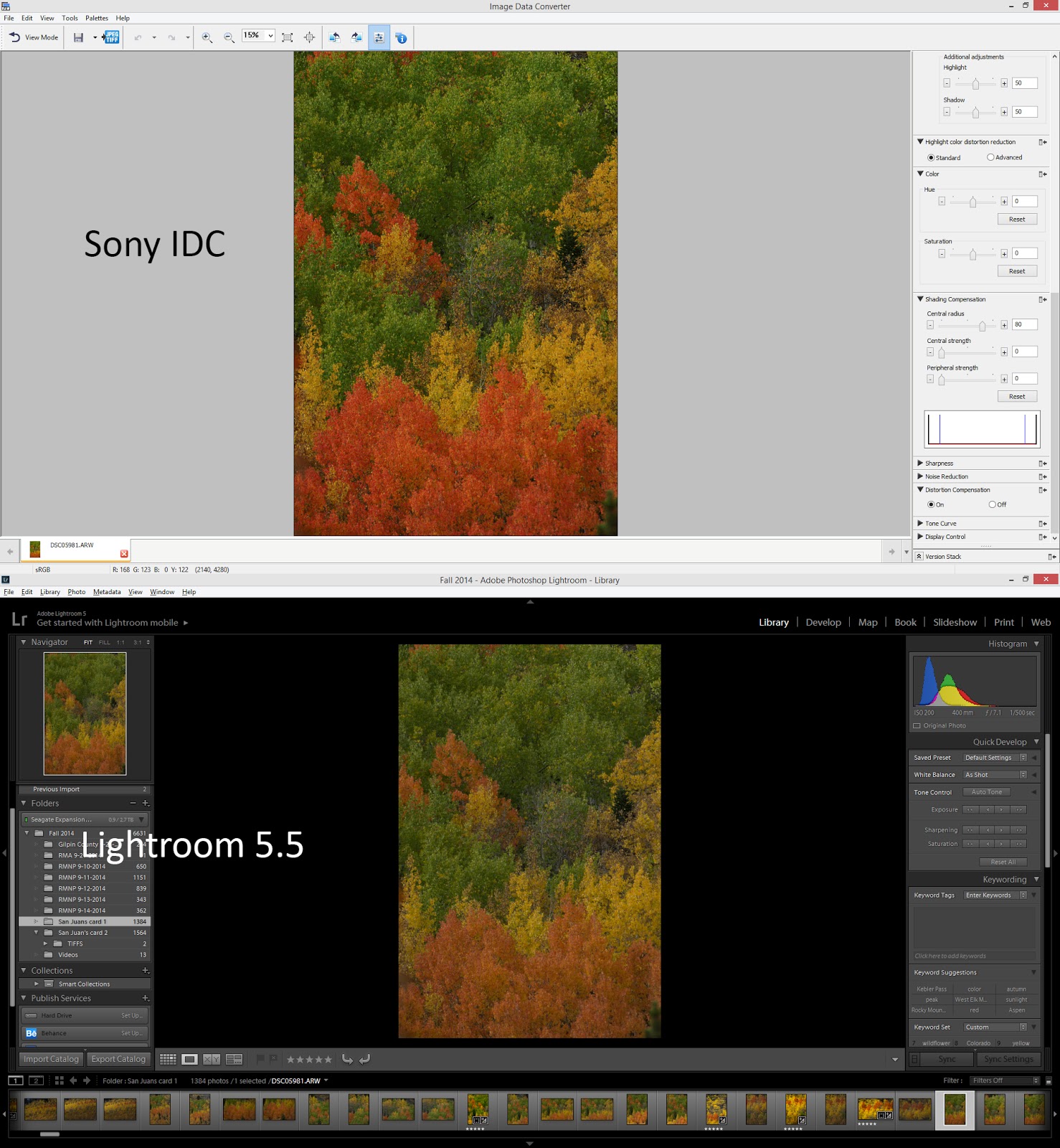
That "open in Lightroom" thing though got me. It got me good. When I did this, I noticed right away a complete loss of color and luminescence. I've always noticed it before but it was really never that big of a deal. However for these photos it was. Gone was the "shimmering effect" the Aspen once had and how they glowed. Lightroom was essentially zeroing out every single thing as far as settings went with my RAW files. Flat out, it wasn't reading the information embedded into the RAW files as far as creative styles go or anything as far as DRO went. What I would see on my cameras LCD would look very different than what I saw when I imported them into Lightroom. No, I don't shoot RAW+JPEG, only RAW. I couldn't figure out why this happening so I went digging.  I found a few threads here and here over on dpreview and flickr which touched on this happening but not a whole lot and then I saw someone mention "Sony IDC". A light bulb went off. 

  
  Like most photographers, the software that comes with our cameras we sort of consider "just there". In fact, I would think most never even bother to install the stuff. After all, we have the latest and greatest software from Adobe. Who needs factory junk which hardly has anything included in it, right? Right. Well....no, not right, in fact....very wrong. I opened up Sony IDC just to see what would happen, expecting nothing at all and just the same thing really. Boring software and no real fine tuning tools. Boy, did I get a shock. Right away I noticed a huge difference. We're talking massive. Everything that was recorded from the time of capture in my camera was retained in full. Everything. All the luminosity was there, the fine detail with the DRO, the shimmering of the Aspen and their colors when I saw them. All there. All retained. Needless to say I was rather elated and excited.


Click for larger size

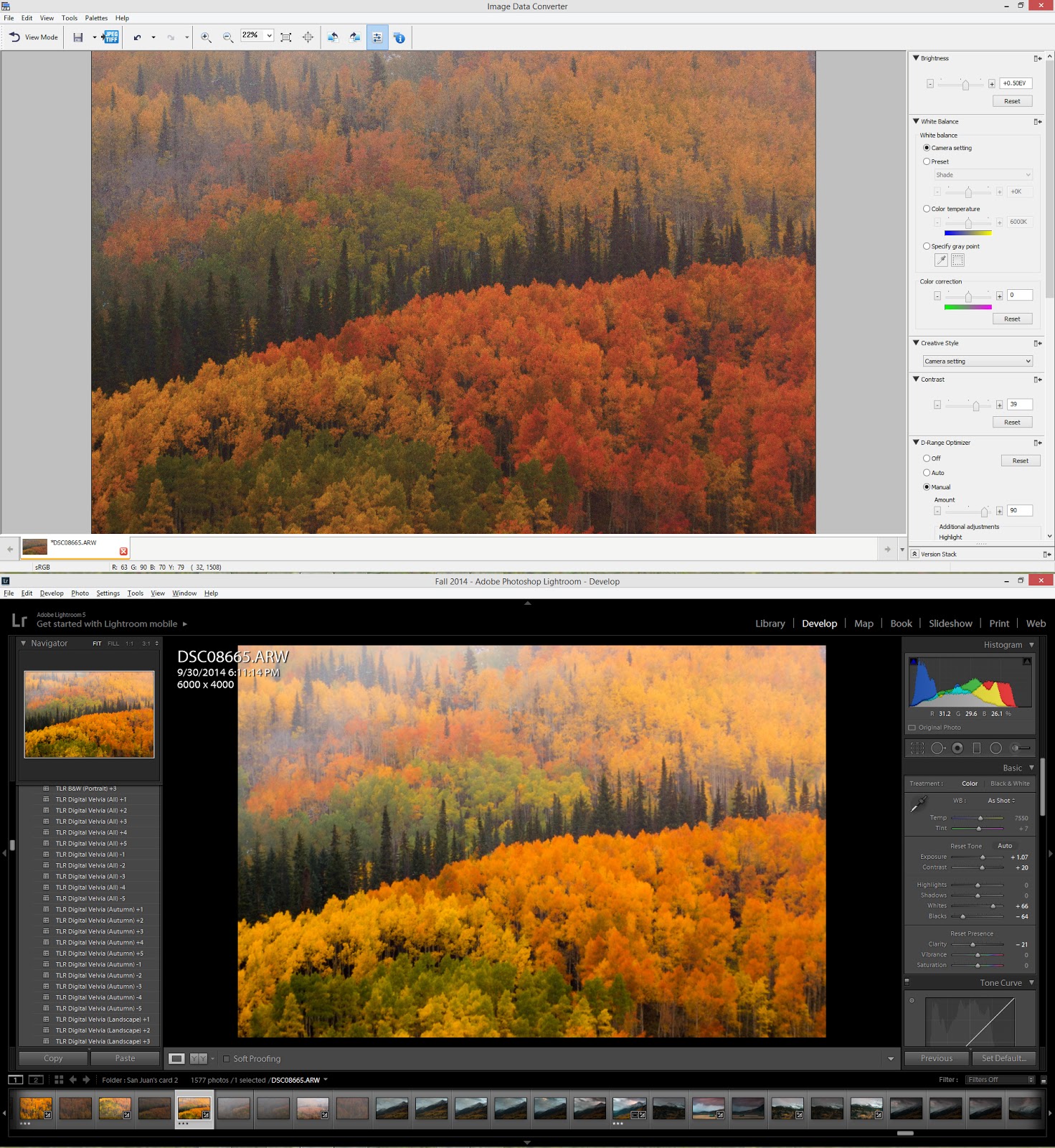
Click for larger size


  Since finding this out I have redone my workflow entirely and now use Lightroom as a more of "in the weeds" app that my go to app for editing. My workflow used to look like this;

*Import photos into Lightroom
*Process in Lightroom
*Export out as a 16 bit TIFF
*Final editing in Photoshop
*Done

  My workflow now looks like this;

*Import RAW files into Sony IDC
*Fine tune exposure, DRO, camera settings
*Save RAW file & export out as 16 bit TIFF
*Open in Photoshop to edit, save TIFF file
*Open TIFF file in Lightroom and do in the weeds editing and keywording

  It sounds like it would take more time doesn't it but in reality it has allowed me to really cut down on the time to edit photos. I no longer have to mess around with trying to get back color from color shifting or retaining DRO which was basically futile. That being said.....

Not without caveats.

  There are some caveats when it comes to editing in Sony IDC and one has presented a real problem which I'll explain. There is a work around for this but it is kind of intensive and unless you know some things inside Photoshop (Lightroom is incapable of helping here) you may have some problems. It's times like this sites like YouTube come in very handy with video tutorials.


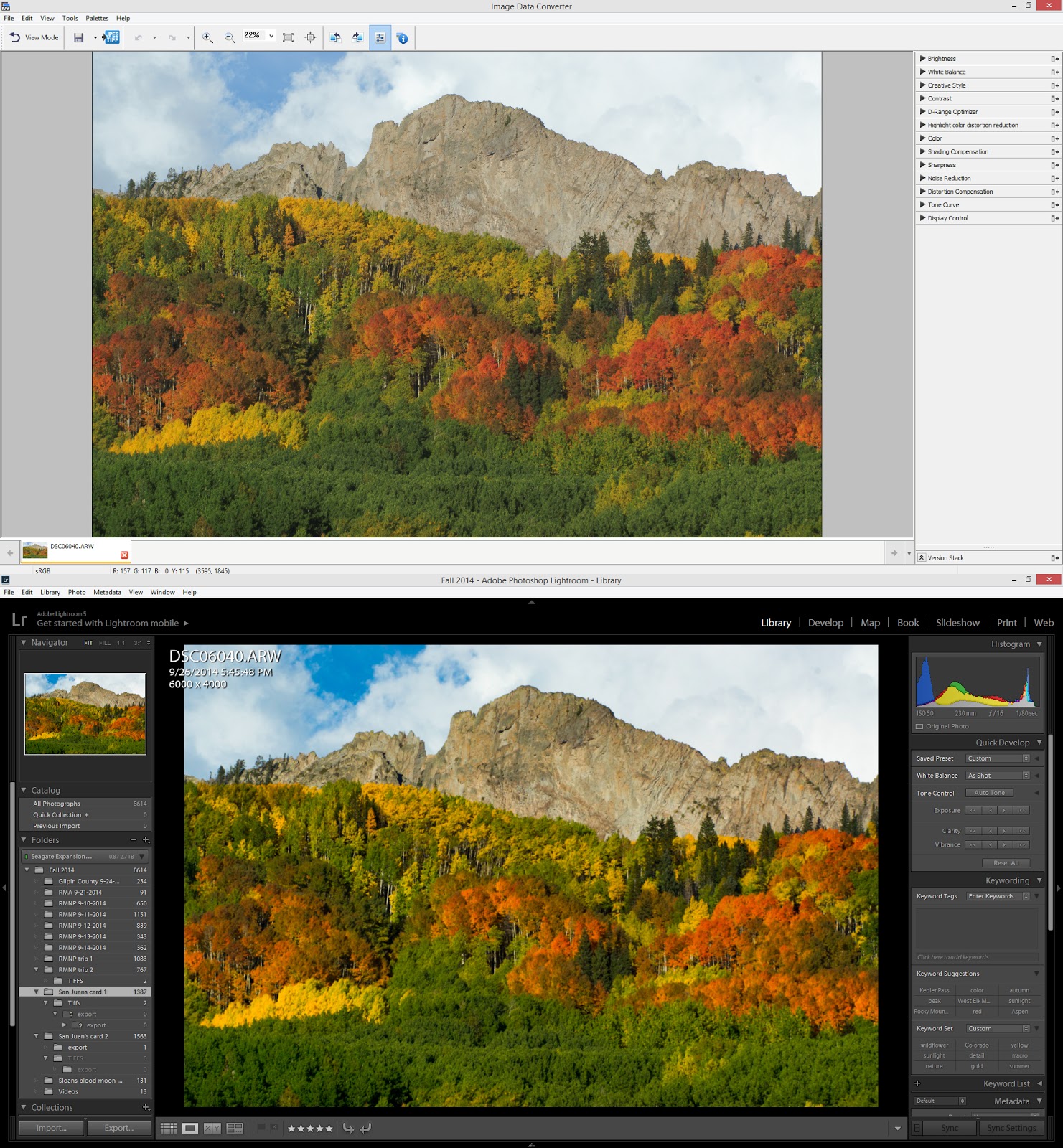
  Sony IDC has issues when it comes to 16 bit TIFF files and I haven't quite figured out why. It may be in the way the files are written themselves and I really need to contact Sony about this and thus far I have never heard this mentioned anywhere. Basically, when you export out a RAW files as a 16 bit TIFF, dithering can occur in skies. It's rather odd considering this shouldn't be happening at all and is basically 8 bit behavior and what you would find with JPEG images and as far as I'm able to tell, it only seems to happen in skies.

The work around. 

  I don't worry about how the skies look inside Sony IDC. Instead, what I do is now process the skies inside Lightroom. Things like DRO and camera settings don't matter much when dealing with a sky. I then export out that image from Lightroom to a 16 bit TIFF file. Inside Photoshop I use layer masking to bring that sky from Lightroom on to the other photo that was processed inside Sony IDC. Problem solved. This allows me to get the exact image I am looking for without the massive loss in quality due to dithering. Intensive? Perhaps. It doesn't take a lot of time however and I believe it's very much worth it. If you aren't familiar with how to use layer masks, simply Google or YouTube it. It's extremely easy and one of the most powerful editing tools in post work. One you use them, you'll always use them.


  The screen shot below is a really drastic illustration of what I am talking about. I was frustrated and was fighting with retaining DRO and adjusting the color shift inside Lightroom. I tried and failed to replicate what I saw in camera. As you can see, the oranges in the Aspen trees is basically toast, gone, as is the dynamic range from DRO which was recorded inside the RAW file from the time of capture. I opened it up in Sony IDC and there it was....all retained. The finished photograph is done using my workflow above (not the layer masking part of course as there is no sky).

Click for larger size


 Click for larger image
click for larger size


  In closing, those of you who shoot Sony may want to take a minute and take a look at your RAW files inside Sony IDC. It's a pretty huge difference and one that I think will probably surprise you.
It's worth the 5 minutes for sure. Be sure to check out my website www.jdebordphoto.com and my facebook page https://www.facebook.com/jdebordphotography  to keep up with my adventures behind the camera.

Yours,
John


Tuesday, September 18, 2012

Tips For Fall Photography

I thought that I would take a second and write this in hopes that maybe it helps some of you out.
Each and every year we see a lot of people write what basically is "make the most for your Fall photos" with hints, tips and tricks and what I have noticed is that much of it is the same. Polarizers, tripods, etc etc. So I thought that I would show you a little glimpse into how I shoot things. Granted, tripods and polarizers are certainly a mandatory affair. No questions asked there.

When it comes to shoot foliage such as Aspen trees and such, I think my method is probably different than a lot of peoples. This is aimed at shooting more intimate scenes, not sweeping landscapes, though it certainly can me used for that however I would say it really is dependent upon the scene itself (then again isn't everything?) Basically I start with an image that I can later correct in post work. I pretty much use Lightroom for everything these days and Photoshop only for resizing and sharpening, along with layer masking when it is called for.

When I am shooting an intimate Fall scene, I generally choose the preset of "Sunset" for my white balance on my Sony A550. I also generally underexpose by 1/3 to 1/2 a stop. Depending upon the lighting, that can drop down to much as a stop. There are a few reasons for this and for me, personally, this is one of the rare times I don't ETTR (Expose To The Right) Highlights can be easily blown within foliage especially when it comes to a scene which involves backlighting and such. The dynamic range within Autumn photography can be gigantic at times and by underexposing, this allows me to retain those highlights. When doing this the darks naturally will be darker so using a low ISO is essential which later doesn't introduce a lot of noise into the image when I am editing it in post work. By using a "sunset" white balance, the images come out very gold. Some may like their images looking like that, some may hate it, however it ensures that the saturation is generally dead on.

In postwork inside Lightroom, I will generally go ahead and just the white balance, finding the whitest point and selecting that. From there I can make adjustments and fine tune the temperature of the scene. Using the Luminance controls, I will then go in and fine tune the highlights to give the image a certain degree of "glow" in fine areas. After that I will adjust the curves and levels accordingly.

Down below is a Lightroom screen cap of the same image side by side. (it isn't finished yet and is a work in progress) It compares what I have in the camera to how I adjusted it mentioning the techniques above. I hope this will help some of you and make you think about your cameras settings this Fall.
---John


Thursday, December 16, 2010

Insights as an artist

For me, art has always been about a few things; 'getting lost in creation', self expression, communication, relaxation, witnessing to others, and maybe some sort of romantic thought process that others may truely see me for what I am, not to mention leaving something behind for loved ones when I am gone and having some sort of legacy. I consider photography as much as a valid art form as anything else, as much as illustration, fine art, design, photography has it's own place among them. I have never understood why so many argue that and I probably never will.


I guess it all started when I was just a kid, I would sit and draw things for hours, usually WW2 airplanes, as my grandfather was a p-38 pilot. I would get lost in doing it and not have a car in the world about anything else. To this day, I still get like that when it comes to post processing my photos...I turn the music on, I unwind, and I dive in. I try not to get to distracted by things on line, so I kind of disconnect from it all, or at least try my best to, when I do. It's always been in my blood, this whole creativity thing. When I was younger they discovered that I had severe learning disabilities, and never ever thought I would be able to read or write because of them. Some things I still have trouble with, math as example being one of those, but what they did find is that my right brain (the creative side) was compensating for the left side (the analytical side) It is kind of funny to see the reaction on peoples faces when I explain to them how I remember things like phone numbers and names, and how I relate it all to color, or how I still play video games at 41 years of age. (I love TF2!)


I see the world very differently I think than many others do, except maybe fellow artists. There are always photographers and always will be photographers who will try to capture a scene as best as it looked like. I tend to do this with mostly all my wildlife shots, as example. But for ever landscape I shoot, I generally have 2 versions of the same scene, sometimes 4 or 5 depending on processing. I almost always have a B&W version of a color shot at the bare minimum, but sometimes and quite often, I also have a more artistic version that involves split tones or a version done with a more retro feel with square cropping and such.Some balk at that and say it is "overcooked" or whatever, but I keep moving along, reminding myself that these same also are generally not my tager market either. I do what I want to, I do what I like, and I do what I enjoy, and I have found the images that are of a more creative nature tend to do better in certain markets than ones which are not, CD covers, greeting cards, etc. At least that has been my experience, your results may vary.


"The Road That Never Ends-cross processed-00076-2""The Road That Never Ends-00076"


I remember reading commentary from an up and coming landscape shooter whose work is quite good, he shoots very realistic, and he said (paraphrasing here) "I don't understand why so many people post song lyrics under a photograph in their artist description. How does a song relate to a photograph?? I don't get that". Ahhh and here is where we separate the artists & creatives from the ones who aren't. Music is visual, at least to me it is, take a look at this set of lyrics below from U2's "Red Hill Mining Town" as example;

 
We'll scorch the earth
Set fire to the sky
We stoop so low to reach so high
A link is lost
The chain undone
We wait all day
For night to come
And it comes
Like a hunter child

 
Now I don't know about you all but I see a LOT of visual symbolism in that. For me, songs have always fit photographs and vice versa. From spot photos used in an editorial or a fictional story, to a CD cover used for a musician, it has always been that way. Can you imagine for example, the Eagles "Hotel California" or The Rolling Stones "Sticky Fingers" without those photos on the covers? How about Bruce Springsteen's "Born To Run"? I can hear maybe a few of you say "but John these aren't songs, they are covers of LP's", fair enough, but to that I would add single releases, which do have covers just like their long play counterparts.


Often times it goes deeper for me, it goes in to what I want the person looking at my work, the viewer, to feel, rather than just documenting a scene as a whole. I want to evolke an emotional response out of the viewer, and sometimes I want that to be a kind of shot that has processed in such a way. I want to stop the viewer in their tracks and make them think, and see the world in a different way, see the world in a beautiful way. I want to have people forget about the days pressures and stress, and be able to get lost when viewing my work. It is THAT emotional impact which I strive for, and the message that I want to get across in my work.You always hear about all these battles about HDR and if it is right or if it is wrong, I have never quite understood that. I have always been of the opinion that if you try to lasso and put restraints one a creative medium, it suddenly becomes no longer creative. There is no right and there is no wrong...something that a lot seems to have forgotten about these days, sadly.


Capitol Liquores, Denver, ColoradoCapitol Liquores, Denver, Colorado-split toned

John


Thursday, November 11, 2010

Is B&W Nature Photography dead?

I wonder if B&W nature photography has gone the way of film...basically dead. I also wonder why more people don't shoot in B&W with traditional nature photography. It is something that has really mystified me in the last few years. I also wonder if digital isn't partially to blame for this....it certainly is a possability I suppose, but at the same time, it has also come full circle in a sense. I see a lot of kids these days who shoot retro themed images, mimicking the look of old skool Polaroid's using Polardroid software (a great free stand alone program by the way) and I see a lot of great Lightroom and Photoshops that many are using on their work these days. But in the traditional nature photography realm...not so much.

I was rather astonished a couple years ago to hear some rather very high profile and well known nature photographers say on deviantART that they simply don't like B&W images. This had me scratching my head, knowing that they all have Ansel Adams listed as one of their favorites, and I kind of wondered if maybe this wasn't more or less a result with being frustrated with the medium itself. Make no bones about it, B&W is harder than color photography, without question, it takes a different eye, and different train of thought, and a different take on a scene as a whole.

I firmly believe that one of the best things that someone can do to better themselves as a photographer is to buy an old manual SLR like say a Minolta x370 which you can have for a song on ebay, and a roll of Tmax and go to town. You gain a lot with knowledge about exposure this way. You also gain a lot with training your eye in seeing things like it hasn't before, not to mention it is just a good creative exercise.

I just wonder what Ansel would say today...and I wonder why more don't shoot B&W. The same goes for seeing photographs which are done in tints and tones, like sepia. I remember reading how Ansel was shown a copy of Photoshop before he passed, and was completely taken by it. . All I can say is thank goodness for photographers like Clyde Butcher who keep the spirit alive. He, in my humble opinion, is the second coming of Mr. Adams himself.  The next time you are out shooting, make yourself a promise to process a few on B&W (don't shoot in B&W mode in camera...just say no to it...it lacks in so many ways I won't even discuss it here) and try it out and see what you get! Who knows, maybe you will find a new love in a whole other style with photography.
---John


"Moonset Over The Towers" Garden Of The Gods Park, Colorado
I wanted a shot that spoke traditional, something that seemed very nature, so I decided to shoot this scene using my Sony a550 and my Minolta 18-200mm, with the sole intention of converting to B&W inside Lightroom3 and a tad touch up with Photoshop CS 5. I really liked how teh scene looked in the viewfinder, and how it had a very almost alien landscape look and feel about it.

Technorati Tags: , , , , , ,

Tuesday, July 20, 2010

Using a super telephoto for intimacy

It used to be I didn't have anything longer in my arsenal than my Minolta 70-300 which I dearly love, but in all honesty I don't use it a lot these days, since I got my Tamron 200-400mm. I really love this lens and having had it for a about a year and a half now, I can fully say that I use it a lot. This past full saw it put through it paces while photographing the Elk Rut in Rocky Mountain National Park, Colorado. It is a big lens and built like a tank, it isn't the fastest at f5.6 continuous but it is sharp. Best thing about the Tamron 200-400mm lenses, is that they can be had for a song over at KEH usually around the mere $200 mark or less. Sure they are used, but you aren't going to get a lens at that price/performance, let alone focal length from anything else pretty much. So if you are looking for something tio start you off in wildlife photography, then I highly recommend this lens.

that is just the thing though. Wildlife photography. That is what generally most think of when you start getting up there in focal length like 400mm. It is pretty much a natural. however, one thing this lens has that many others don't, is 1:2 Macro ability. Close focusing goodness, which, as I have come to find out, can make for some very interesting images at 400mm.

This has opened up basically a whole other world of photography for me, with a whole other shooting style, being able to do things which before, I had never really done, either because I didn't have the focal length, or because I honestly failed to ever see it/notice it. As photographers, we are always evolving, looking for ways to shoot differently, to be more creative with our work, and to try something which we have never tried. When I first got this lens, my sole intention was birding, and it then that I realized what I had been missing on one of the first photoshoots I ever did with the lens. I was looking through the viewfinder of my camera, and I locked on to something which I wasn't trying to lock on to, some cat Tails in a marsh, and then, it just sort of came to me. The wheels in my head started turning, and I started scanning at 400mm with the lens, seeing things, seeing the intimate details of nature which I had never noticed before.

One of the fun things to do with this lens is landscapes from a distance, it is amazing what you can see which the naked eye can not, it has opened up a whole other world essentially which I otherwise would have completely missed. The trees on the mountainside, subtle changes in light, winter weather conditions, etc. Florals also can be a lot of fun, especially in what would be otherwise harsh lighting conditions, where I would never even think of doing a landscape image. Backlighting can be fun to work with.

So the next time you are out with with a super telephoto, don't forget to take a minute and notice the smaller, more intimate details around you. You very well might be amazed at what you find!
--John

Images below shot using my Tamron 200-400mm lens on Sony and Minolta dslr's.


Technorati Tags: , , , , ,

Friday, April 9, 2010

The Long Landscape

  A couple days ago I had the chance to once again shoot up in Rocky Mountain National Park. Naturally I jumped at the chance at being able to visit one of my favorite photo destinations. What awaited was a display of Winter battling Spring in full force, with snow showers, full on snow storms, combined with sunlight at times, making for just very dramatic atmosphere. I really love the time of the year in the Rockies of Colorado.

  It got me thinking though as I was shooting around Hallet Peak, as I shot with my 400mm surveying things, panning for interesting detail and composition. Today I thought that i would take a few minutes and write my thoughts down and share some examples of this photo shoot with you all....so about the title of this blog post "The Long Landscape"....

  How many of you own a lens that is 300mm or greater? Usually we think of such lenses for shooting things like Birds, Wildlife, etc...but how many of you have actually tried shooting a landscape with it? Zoomed all the way in at max focal length? In a sense it is kind of like macro photography, how the goal is to capture things which the human eye often can't see, only this time we can sometimes see it but we don't have the ability to really notice the fine details and intimacy with the human eye. It is literally like shooting a whole other world, noticing things we would have missed otherwise.

  When I was looking through the viewfinder while shooting, I kept saying out loud "wow...just wow!" because of the things I was seeing that I couldn't see without a long lens. The trails from the snow tumbling down the mountainside, the Pine trees completely untouched by man, sitting at 12,000 feet high, and how thyey are battling the early Spring snowstorm. The light as it reflected against the falling snow....the finer details.

  Often times shots like this can give an excellent sense of emotion, atmosphere, and as I said, intimacy. I often find that compositions in shots that are done in this style can be stronger and also more powerful. The ability to get in close and really work the scene with a ling lens, studying it, taking your time, and really examining it, can be incredibly rewarding.

  So next time you are out shooting a scene, try it and see what you get! You may very well be shocked at what you find when looking through a long lens! Here are a few examples that I recently took using this technique. Focal length was between 300 & 400mm using a Tamron 200-400mm on my Sony a550.
John


, , , , , , , , , ,

Saturday, March 6, 2010

Chasing The Light

I don't shoot much during the dull times of mid day light, and I imagine many who take their nature photography don't either. Of course, now and then the situation arises where it is ideal, I find that to be a rare thing. One of the things I have always told people, that the easiest thing to do to improve their photography, outside of buying and actually USING a tripod, it to shoot during the times of the day when the light is the absolute best. There is nothing else that will have such a dramatic impact on your images as this, and it is 100% free as well. If I may, I would like to share a quote with you all that really rings home;

"Hate to break it to you, but serious photographers don't get a lot of sleep. Show me an award-winning, breathtaking landscape--a pond shimmering in the woods, golden clouds surrounding a mountain peak--and I'll show you someone who got up at 4:40 am to be ready with a tripod as the sun rose." David Pogue, NYT

  Now if that doesn't say it all, I honestly don't know what does. If you take a look at some of the best shooters today, guys like Ian Plant, Guy Tal, Jesse Speer, and the images that they produce, you will see almost everything is done with exceptional lighting taken during the morning or late in the day when the light casts it's golden hue, in and around Golden Hour. In fact, there is an online calculator for finding the exact times of when Golden Hour is and I would encourage you all to check it out "The Golden Hour Calculator" What makes this site unique is that is specific down to the exact location in teh world where you live and or shooting at.

Now go get busy and take some of the best shots you have taken with dramatic light, as I said it is teh easiest and cheapest way to improve your photography! below are some of my personal selections from my photography that show dramatic lighting.
John


Technorati Tags: , , ,

Friday, May 29, 2009

The Musings Of A Photographer

The disgruntled upgrade path of a photographer---- Honestly Sony, wtf are you doing?!?!?! I don't know what exactly I am going to do now, but I think my plan is this; to go with what is now an "older Alpha", probably a200, a300, a350, and just wait and see. The newly released Alpha's have me more than disappointed, honestly. They lack features, features which I use in my everyday photography, and are clearly aimed at what I can only describe at Soccer Mom's. In fact, someone on the dpreview Sony dslr forum made the comment "The girlfriend dslr has officially landed!", while someone else said "Wife Camera 101 debuts!" (Seriously who the hell thought of a PINK lcd screen on the camera? WTF!?!?!?) You can watch the youtube review of 2 of the 3 new dslr's here I like how the Sony rep states "The a200's successor", ya, sure, lol It is dummied down for geeze sakes!

So here I sit, debating about all this, and wondering what exactly Sony is doing. I am going to have to sell my current dslr and a couple lenses (now ya all know WHY I bought 3 lenses from Ritz) to buy my new body eventually, which will happen in a few months. Sure, an a900 would be nice, is it realistic? No. Especially NOW considering all this and the fact that my money would be better spent in other real life issues. So I have come to a conclusion. I may just buy a cheap used a200 for now, and play the wait and see game, for a few. I am honestly very disappointed in these new cameras Sony has come out with, these are very beginner cameras, more so than any other out there and make a d40 look like a pro level camera.

If I don't like what I see, well, my only hope then is that Fuji releases the s6 Pro. Otherwise, I may just hop into a s5 Pro. Other than that, Pentax I have always liked, a lot, and Bestbuy has the Nikon d200 on closeout for $599.

How bad is bad? Look at this post on dpreview:

"Sony entry level DSLR's - redefining the term Upgrade

A100 had MLU, DOF preview, AEL button and SSS switch
A200 only had the AEL button and SSS switch
A230 has none."

The A200 was 70 gram lighter than the A100 and most people who handled both agree that build quality seemed to be worse with the A200. The A230 is 150 gram lighter, so I wouldn't be surprised if it feels like a cheap toy. To make matters worse, its framerate is now lower too (2.5fps vs. 3.0fps in the A100 and A200).


Does anyone want to guess what will go next? For the A260 I bet Sony is considering to drop PASM and RAW. After all, who need those?

I hate this crap. Minolta, where art thou? Please come back and save us, we dearly miss you more than we can say.....


Hey Photo Forums? Guess what? It's 2009! Wake up!--- You know what I can't stand, and is a serious pet peeve of mine? Photography Forum sites that only allow 700px-800px photographs on the longest side is what I can't stand. It is 2009, wake up! This usually equates to people posting photos from their flickr site that are like 400px in size. Seriously. How the hell is anyone supposed to see ANYTHING at a resolution of 400px? It's 2009, 24" monitors are the norm this day and age. If you didn't know, your ass better call somebody! I didn't join 4 forums because of this rule, the 2 exceptions is naturephotographers.net and naturescapes.net which only allows 700px on the longest, because, well, the info one gains there is next to invaluable.

Shutterstock CEO--CSR Skills Much? FAIL!--- Seriously, want to see how NOT to talk to your contributor base? This is ridicules and shows not only complete lack of respect but arrogance as well.

A little history first---The IRS is for some reason withholding taxes of international contributors on Shutterstock, even though they are not citizens and pay NO US tax. They have a right to be pissed, I would be too. There has been a massive outcry and well, there should be, as well. (Last I heard, wasn't America essentially founded on the catchphrase "No taxation without representation"? So do they get to vote in our elections then?) Check this out on the Shutterstock forums

Here is the post on how the CEO of Shutterstock responded to the community (not the way to address your clients mind you IMO. BAD customer service defined!)

Witholding Tax Issue - Calm down.

Okay.


1) This is a US government regulation. What would you like us to do about it? Go to jail? Go out of business? We are sorry - but we can’t just move the company out of the US or creating another company somewhere else to pay you. That is called tax evasion. These are laws. We can’t change the laws. We have 60 employees in NYC - they aren’t going anywhere.

2) If you follow the rules you won’t be double taxed. Your country has rules that we follow every day also. You may need to do a bit of work here, but we will help you out with them. You will have a chance to get your ITIN before we start following regulations and witholding.

3) If you don’t want to deal with this, then leave. We are happy to remove all your images for you. If I continue to read threads on the forum that you will be taking your images elsewhere, I will delete them myself and close your account. I’ve done it a few times already- I am not kidding about this.

4) Online petition claiming we are taxing you? Why would we be taxing you? Again, this is the US government. We are just following the law.

5) Want to change your avatar to something obnoxious? Again, I will personally delete your profile, images, etc. You are just creating more work for us.

6) If you think other microstock companies are except from paying tax, think again. It’s a matter of time before they start following the law also.

7) Why don’t US citizens have to deal with this? Because we already have their W9 forms. Don’t worry - they dealt with it also.

8) Welcome to doing business internationally. We will all make money together - but we have to follow the rules.

9) We will answer every single question you have - but you have to give us time to get to them.

Jon Oringer
Founder/CEO
Shutterstock Images LLC


Captured this past Sunday at Mount Evans Wilderness here in Colorado, Bristlecone Pines are the oldest living on the planet, it is amazing to think that some of these trees are literally thousands of years old, imagine the stories that they could tell if they could speak! To see more of my images, click the photo which will take you to the gallery on my website with the photos from my trip!Technorati Tags: , , , , , , , , , , , , ,

Monday, May 25, 2009

Countrified!

I have this obsession with images of nature and images of a rural setting, and when they come together it just always seems like such harmony is being created.

Captured yesterday outside of the Mount Evans Wilderness area here in Colorado, by the Chicago Creek Camping area, I am not sure I can find all the words to put this shot into perspective but I will try my best.

One of the great things about Colorado is exploring, it seems down every road that you have never traveled on, something photographic is always there within seconds, and this was one of those places, I have always wanted to explore this area some but just never really have, maybe it's fact I have always thought it was a rough dirt road, but while it is a dirt country road, it wasn't rough. The creek and river flowed right next to the road with old beautiful country cabins dotting the landscape next to it, when I saw this sitting in the yard of one, covered by wildflowers. I actually almost missed the scene completely, but luckily I JUST saw it. I didn't have the lens on really I wanted, as I had my Tamron 200-400mm on my camera at the time, but decided what the heck, and had at it.

It is hard to describe the sounds I heard when I was shooting this, but let's just say that between the constant buzzing of Hummingbird's, the soft roar of the river, and the very strong scent of wildflowers mixed with the incoming rain, THIS was SERENITY defined! Not a sound of man anywhere, nothing, nada.


Technorati Tags: , , , , , , , , ,

Tuesday, May 19, 2009

Something To Ponder

Some of you may recall the recent journal I wrote titled "Ponder This" and this Tuesday morning, while reading my Twitter stream, once again, I saw a post that made me think and kind of made me take notice, you can say.

This one comes from danielwharmby (Daniel Wharmby, a California based professional editorial photographer some of you may know, his website is here and if you aren't following him on twitter, you should be! Like NOW!) What he posted just made sense. Pure sense;

--My instructors used to say "There's no point going around the world if you can't tell a story in your back yard."

Now how true is THAT!? How often do we sit around dreaming of being able to go and shoot somewhere exotic, while often we don't realize the incredible locations we have at our very own dispose. I know often I do. There are a billion locations here in Colorado that I still want to shoot, and haven't yet. Heck, it was only a couple years ago that I discovered one of my favorite gems to shoot, South Valley Park, which is tucked away in a subdivision here in metro Denver of all places. It is one of the best kept little secrets around, and is like a mini Garden Of The Gods kind of place.

How often do you guys get out and actually explore where it is you live and shoot? Have you ever checked your local parks and lakes? You might be quite shocked, I know I certainly have been several times.

Often it seems that paradise is close by, but rarely we see it. However when you open your eyes and starting to take notice, you start to notice the very things which are around you! And believe me, beauty isn't always that far away!


South Valley Park, Colorado....a little local gem of a location almost in my backyard

Monday, June 23, 2008

Sharing Some Processing Secrets

Yes, you read correctly the title. I thought that I would go ahead and share some of my secrets with you guys and how I process my photos. Why? Well why not!?!? I get a LOT of notes asking me "How did you do this and that?", "Can you help me with.....?", "I am curious how you got the look of such and such shot.....", etc. etc. So I thought that I would go ahead and basically tackle everything in one journal. So buckle up. go grab a cup of Joe, pull up a chair, and get ready to dive in! Away we go!

I shoot everything in RAW. And I am of the FIRM belief that if your camera has the ability and capability then you should be too. About the only exception I can see is if you are a sports shooter and your camera can't do 8fps in RAW when you need it. In reality, I don't know of anyone on DA who does that kinda work. There probably is somewhere though. There is just NO excuse for not taking your images in th ebest possible settings and at the highest quality allowed.

The whole creative process is essentially 2 fold for me. Basically when I am out in the field shooting, I know how I want a shot to look already. I study the composition and choose an angle which I feel works, cropping in camera, trying different focal lengths, etc. This is usually part one, so in my head I know what I want. Now this can and often gets totally turned around 180 degrees when I download my shots and I start the post work processing. Often times, I will change the way I wanted the shot to look in the field, inside PS. B&W, Sepia, Cropping, etc. Often I edit and then I compare..mentally and physically. Sometimes I like it how I shot it, other times, I prefer something else.

Now some of you may be surprised by this next one lol My camera's white balance is almost ALWAYS set on 'sunset' white balance. Why? Well...basically what I have discovered on my camera is this---when I shoot this way, everything has a yellow & orange tint, and often these colors are very hard to expose for correctly. By having my white balance as such, it allows me some greater flexibility when I go to edit my shots. Seeing as I shoot in RAW, my white balance is totally adjustable. So I can always fine tune it, but doing it first in camera allows for a lot of speed and also accuracy. I first started doing this last Autumn when I was shooting the colors of Fall, and since then I haven't changed it really.

Filters. A Circular Polarizer is absolutely mandatory, and Neutral Density filters are not far behind.

I use essentially 3 RAW converters in my workflow---Lightroom, Photoshop's ACR, and AcDeeSee Pro Photo v2. So why 3? Because they each do different things. There really isn't one whole solution that I have found yet when it comes to editing RAW files. Lightroom can do things AcDeeSee can't and vice versa. So I will use one if I am wanting a specific look & feel for a shot.

LucisArt is used in almost EVERYTHING I process. One of the great things about this program is it's ability to recover specific areas of dynamic range in a shot, like adding the sun's highlights on the blades of grass. The info is already contained within a photo, but by using LucisArt, I am able to bring that out farther.

Fred Miranda Photography Plugins & Actions are used constantly for final results. The "Intellisharpner" plugin is the greatest thing since sliced bread and I also use the "Velvia" and "B&W Workflow Pro" with regularity as well.

Layer Masking...and what a Godsend that is! Live it, love it, breathe it! For those of you who wish to see a technique similar to mine using layer masking, but a lil more in depth than mine, head over to the BlueHourPhoto Blog for a video demonstration.

I shoot almost 100% of my shots in ISO 100, and sometimes use ISO 80 or 200. Rarely ever will I shoot above that....unless I need a shot off FAST. But generally, I shoot in lower ISO ranges.

HDR. Sometimes I know when I am shooting a shot if it will be HDR, other times I don't know til I am editing. Some shots are made for the technique while others don't work at all for it. Not all shots have the look and feel that is right for it IMO.

I actually don't use my tripod much unless I am needing a longer exposure say with waterfalls, or if the light is low. I know I should, and don't get me wrong, I do use it, but often when I am shooting, I sometimes need to be fast, cuz I am holding up traffic behind me while I am out in the middle of the road! lol

I use Noise Ninja exclusively for Noise Reduction in post work and every shot incorporates it and often combined with layer masking as well. It is an essential part of my workflow.

Every single shot I take
has the curves, levels, and exposure adjusted. Call it fine tuning if you will. Again, essential part of my workflow.

I don't have or use a dedicated Macro lens, instead I use my Minolta kit lens, an 18-70mm zoom that has 1:2 Macro capability, along with a set of macro filters (close up diopters) that screw on the end of my lens and can be stacked for greater magnification. These are cheap, 10- off ebay! And they work excellent!


Well that be about all that I can think of at the moment, if anyone has any questions, just feel free to ask me, and I will do my best in answering. I know there is a lot more that I do, but it is early yet and my brain doesn't function it's best at this time of the morning on Sunday's lol

I hope you all are having a nice weekend. Mine is going pretty good. Yesterday's photoshoot in Rocky Mountain National Park yielded some nice results. A little about that real quickly----it was rather challenging for me, as I was with a friend and we left late. But I was of the mind set that this would be something different, shooting in not optimal and harsh lighting, so I took it as a challenge. And if anything, it forced me to look and see things differently, and to look closer and not so much at the massive view styled landscapes, but something of a more intimate and closer flavor...immediate surroundings. I came out doing pretty good. Now if someone can just hold off the tourists...sheesh what a damn zoo it was. To many people, now ya know why I leave at 4am! So there were like 20 cars pulled off the side of teh road, all these people had their lil cameras taking pics, we pull up and here is this HUGE Bull Elk standing in a river in the middle of the forest 15 feet from the road. I roll down my window to fire a shot off with my 75-300 and all the sudden....I see someone ass in my frame! I was all 'wtf.....they are to close!" And I back off my lens to see this VERY GOOD looking redhead in a miniskirt, about 25, and I yell out, "you are to close to him! you are putting yourself in danger!" And she looks back at me, like I am being rude. So I say "Never mind the fact that your ass is a closeup in my 300mm and is about to be plastered all over the internet too! Not that I mind, you have a nice ass, but hey! Just a FYI!!!"..she moved but by that time the damn Elk was gone! Ugh people!
A few shots down below from RMNP......enjoy!
---John


Technorati Tags: , , , , , , , , , ,